You open your mailbox and find an unexpected email.
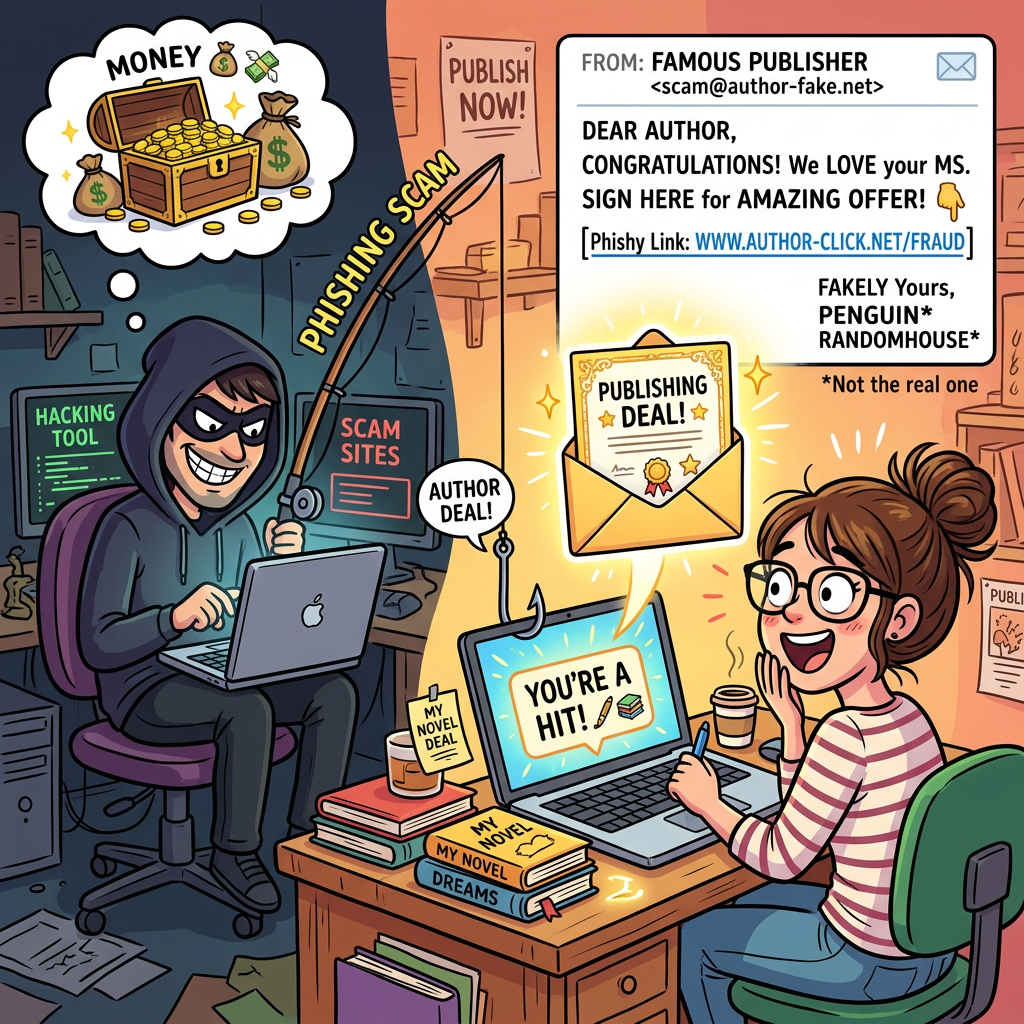
It’s from a famous author, or a publisher, or a marketer or publicist, or a literary agent, or somebody wanting to adapt your manuscript into a film.
Well, it’s somebody interested in you and/or your book.
The email itself is flattering. You’re taken aback. Somebody’s noticed your work! How good does that feel?
And it’s not just somebody, but somebody of note.
But here’s the thing.
Here’s the problem.
This email?
It’s a crock.
You’ve been spammed.
Sometimes, it won’t seem the case because they’ve given you specific feedback on your book – and the feedback does feel personal. But this is the magic of a cold reading.
For example, imagine you’d written a tell-all memoir with the intent of helping others and you got this email:
I came across your work recently and was incredibly moved by your profound insights into the human experience. Your unique blend of personal vulnerability and actionable wisdom truly sets your writing apart. The way you weave together your own life journey with practical steps for personal growth is both deeply inspiring and exactly what our audience needs to hear right now. It is clear that your background has given you a powerful, distinct voice that resonates with anyone looking to overcome obstacles and unlock their full potential.
Oooh. Based on that, they must’ve read your book. Surely!
Guess who wrote this response? AI. It took a millisecond. I gave it the criteria, it spat out this response (and more). And it sounds entirely personal and engaging.
Other emails mightn’t talk about your content, but the opportunity they present. A writer might suggest talking about craft. Somebody might come along with an amazing marketing opportunity. A publisher might express interest in your writing.
Sometimes, it’s not even this sophisticated. Sometimes, it’s as even as simple as:
Am I talking to the author?
Or:
Can we talk about your book?
Whatever the advance, it exists only to engage you. Once they do, they’ll open a conversation with you.
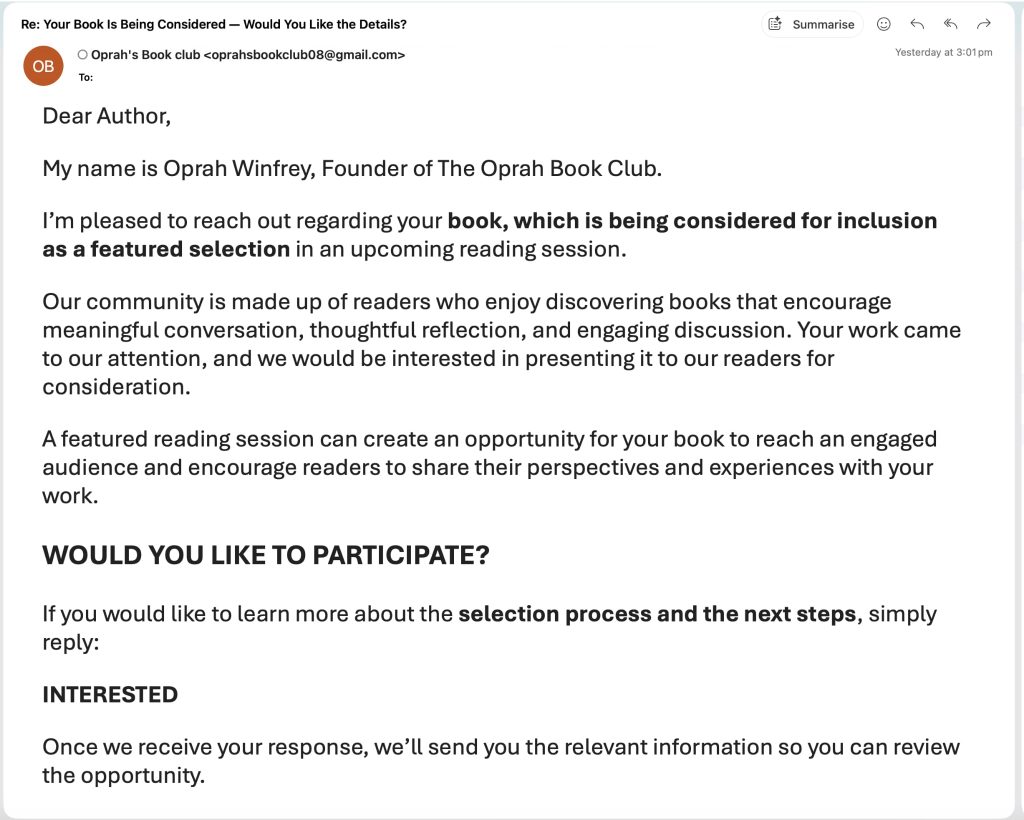
Recently, I was hit up by the Oprah Winfrey Book Club:
Thanks, Oprah!
Oh wait – look at the email address:
According to Gemini, Oprah is worth 3.4 billion (US), and we’re expected to believe she’s operating out of a Gmail account where she can’t even get her own unique name?
Gemini says the historical email address for her is oprah@oprah.com. This is what you’d expect: something like @oprahwinfrey.com or @oprahwinfreybookclub or @oprahbookclub or something like that. She can afford her own domain.
Stephen King’s another who contacted me:
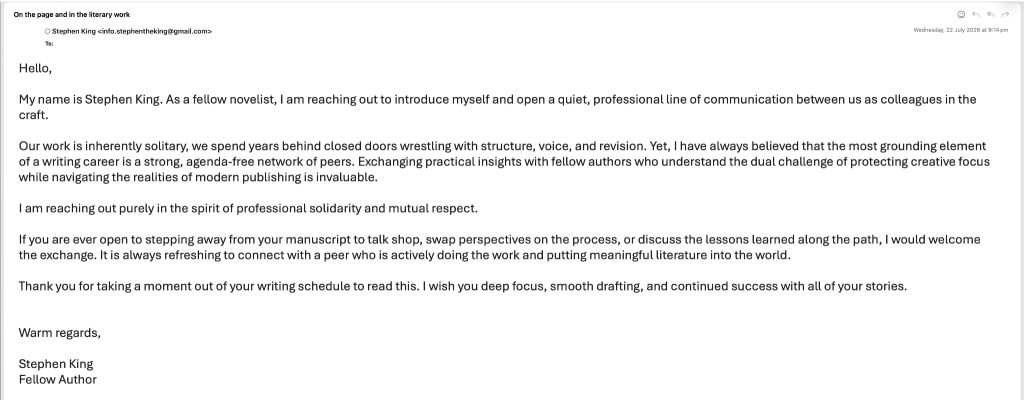
Look at his email address:
Break his name down there: Stephen the King. I never knew Stephen King was so vain.
International bestselling author Sally Rooney is another who’s on the prowl:
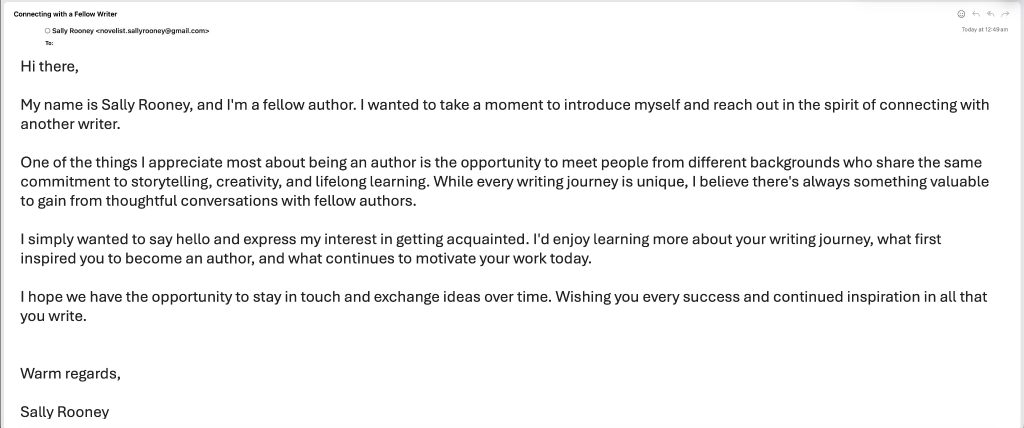
And how do I know this is the real Sally Rooney? Well, just look at her email address:
novelist.sallyrooney@gmail.com
Just in case I didn’t know she was a novelist, she threw that into email address
Gmail addresses are common in spam. There are legitimate individuals and businesses who use Gmail accounts or other web-based emails, but in the cases of these seemingly prestigious solicitations, you’d expect they’d have an email address based on their domain name – even if they don’t have a website.
These bastardized email addresses are one of the quickest indicators of spam.
At some point, they’ll offer some sort of service – a reading fee, or an opportunity for marketing. It could be anything. They’ve drawn you this far and you’re emotionally invested. So why not consider the opportunity? It’ll be good for you and your book, wouldn’t it? This person certainly seems credible.
Spam has increased drastically lately, and we’ve had several authors contact us with what they thought were legitimate solicitations.
Maybe somewhere in the world there’s been a legitimate solicitation made through email, but if you were to treat 99.9999999% of any such email you received as spam, you’d be still be underestimating just how pervasive this is.
Be vigilant.
If, in doubt, then feel free to contact us.