
Busybird
Welcome to the Busybird blog, where you can find helpful articles, updates, industry news and more. Make sure you stay up to date by signing up to our newsletter below.
The Trojan Scam
October 6, 2026You open your mailbox and find an unexpected email.
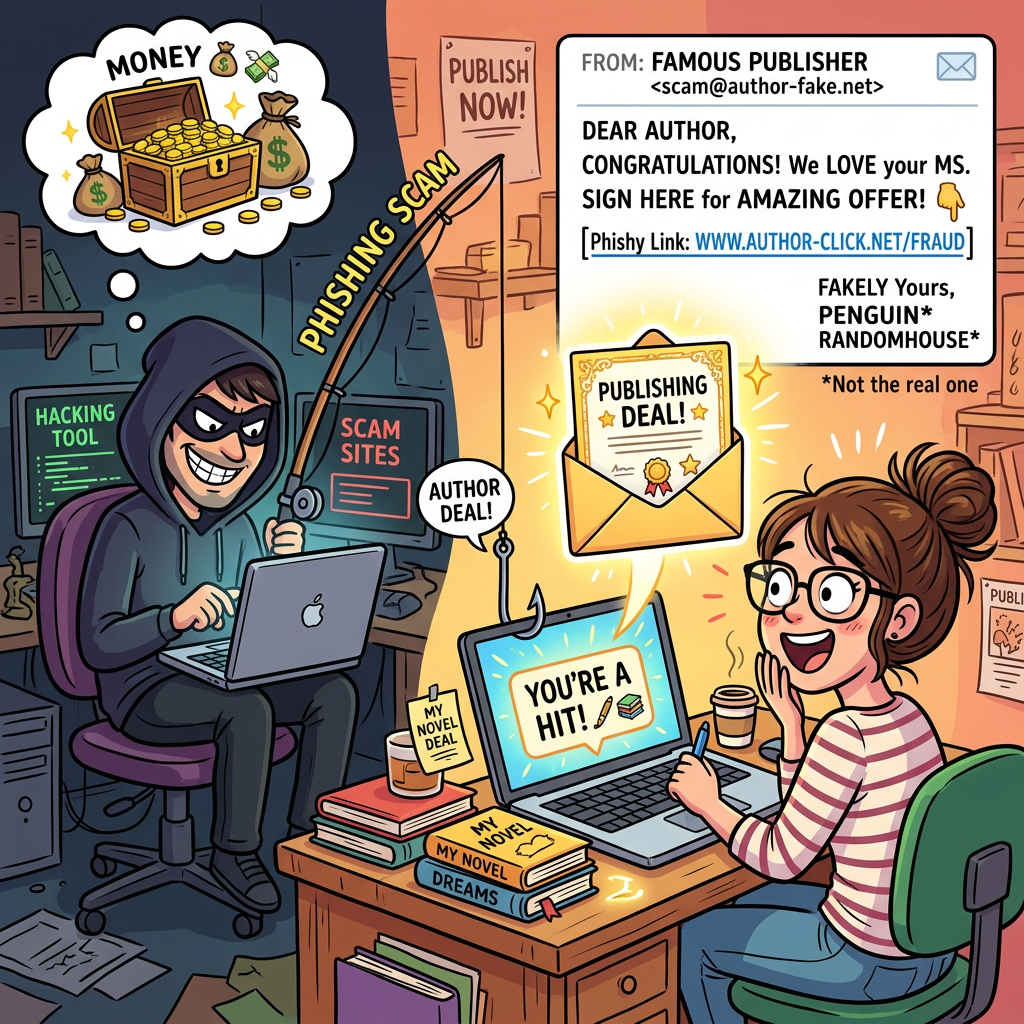
It’s from a famous author, or a publisher, or a marketer or publicist, or a literary agent, or somebody wanting to adapt your manuscript into a film.
Well, it’s somebody interested in you and/or your book.
The email itself is flattering. You’re taken aback. Somebody’s noticed your work! How good does that feel?
And it’s not just somebody, but somebody of note.
But here’s the thing.
Here’s the problem.
This email?
It’s a crock.
You’ve been spammed.
Sometimes, it won’t seem the case because they’ve given you specific feedback on your book – and the feedback does feel personal. But this is the magic of a cold reading.
For example, imagine you’d written a tell-all memoir with the intent of helping others and you got this email:
I came across your work recently and was incredibly moved by your profound insights into the human experience. Your unique blend of personal vulnerability and actionable wisdom truly sets your writing apart. The way you weave together your own life journey with practical steps for personal growth is both deeply inspiring and exactly what our audience needs to hear right now. It is clear that your background has given you a powerful, distinct voice that resonates with anyone looking to overcome obstacles and unlock their full potential.
Oooh. Based on that, they must’ve read your book. Surely!
Guess who wrote this response? AI. It took a millisecond. I gave it the criteria, it spat out this response (and more). And it sounds entirely personal and engaging.
Other emails mightn’t talk about your content, but the opportunity they present. A writer might suggest talking about craft. Somebody might come along with an amazing marketing opportunity. A publisher might express interest in your writing.
Sometimes, it’s not even this sophisticated. Sometimes, it’s as even as simple as:
Am I talking to the author?
Or:
Can we talk about your book?
Whatever the advance, it exists only to engage you. Once they do, they’ll open a conversation with you.
Recently, I was hit up by the Oprah Winfrey Book Club:
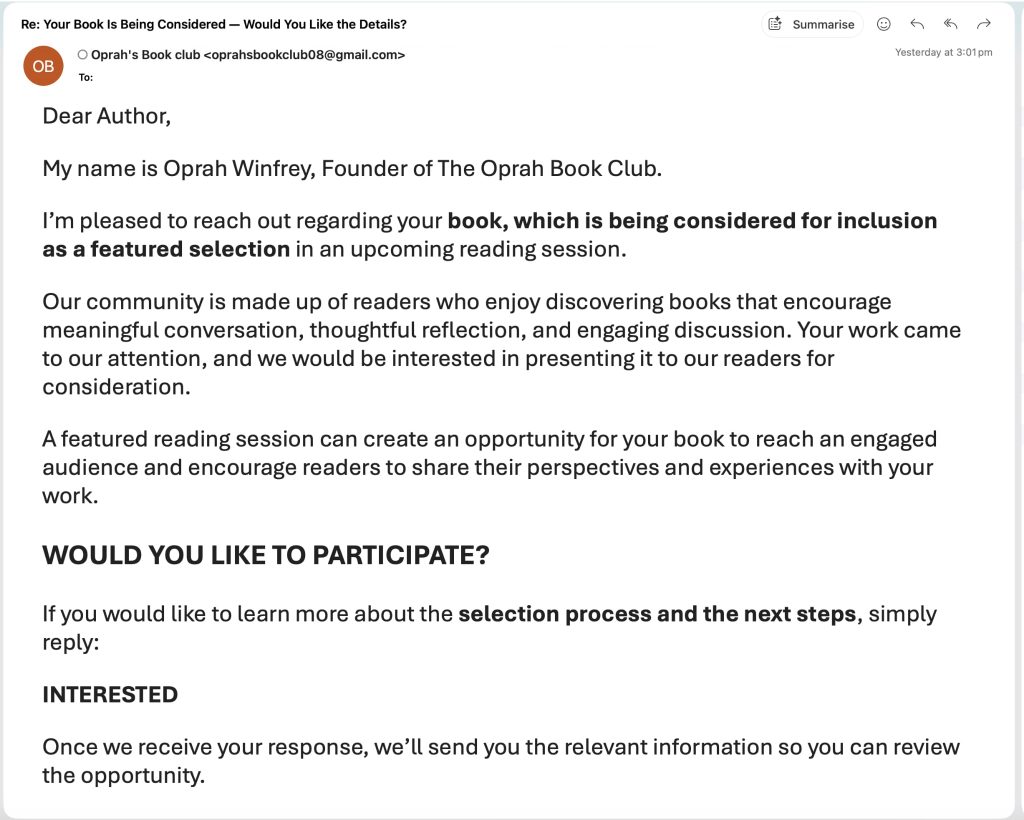
Thanks, Oprah!
Oh wait – look at the email address:
According to Gemini, Oprah is worth 3.4 billion (US), and we’re expected to believe she’s operating out of a Gmail account where she can’t even get her own unique name?
Gemini says the historical email address for her is oprah@oprah.com. This is what you’d expect: something like @oprahwinfrey.com or @oprahwinfreybookclub or @oprahbookclub or something like that. She can afford her own domain.
Stephen King’s another who contacted me:
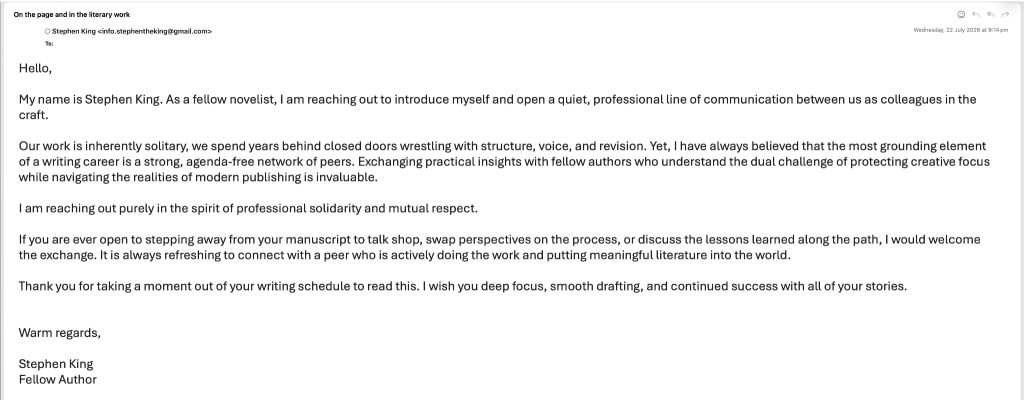
Look at his email address:
Break his name down there: Stephen the King. I never knew Stephen King was so vain.
International bestselling author Sally Rooney is another who’s on the prowl:
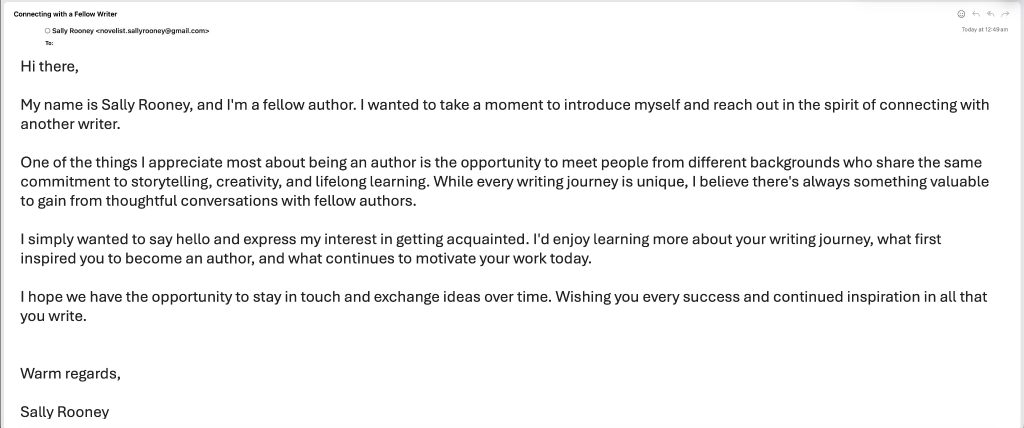
And how do I know this is the real Sally Rooney? Well, just look at her email address:
novelist.sallyrooney@gmail.com
Just in case I didn’t know she was a novelist, she threw that into email address
Gmail addresses are common in spam. There are legitimate individuals and businesses who use Gmail accounts or other web-based emails, but in the cases of these seemingly prestigious solicitations, you’d expect they’d have an email address based on their domain name – even if they don’t have a website.
These bastardized email addresses are one of the quickest indicators of spam.
At some point, they’ll offer some sort of service – a reading fee, or an opportunity for marketing. It could be anything. They’ve drawn you this far and you’re emotionally invested. So why not consider the opportunity? It’ll be good for you and your book, wouldn’t it? This person certainly seems credible.
Spam has increased drastically lately, and we’ve had several authors contact us with what they thought were legitimate solicitations.
Maybe somewhere in the world there’s been a legitimate solicitation made through email, but if you were to treat 99.9999999% of any such email you received as spam, you’d be still be underestimating just how pervasive this is.
Be vigilant.
If, in doubt, then feel free to contact us.
Get Out of Your Bubble
September 8, 2026
As a writer, you need to be challenged.
This can be hard to face. Challenged? What if whoever’s challenging me doesn’t like my work?
That will happen. Think of any great writing – any classic book – and there’ll be people who don’t like it. Opinions are subjective.
But that’s not the challenge we’re talking about.
We’re talking about somebody who’ll challenge where your writing might not be fulfilling its potential.
Now that could happen for any number of reasons.
Among them (and this is, by no means, an exhaustive list):
- clarity: is what you’re saying clear?
- overwriting: are you waffling?
- underwriting: is there something you haven’t explored deeply enough?
- repetition: have you repeated yourself, or are there words you repeatedly use?
- chronology: does the order of information make sense?
- characterisations: are they motivated and three-dimensional?
- causality: are contrivances and coincidences driving your plotting?
- plotting: is it sound?
- dialogue: is it realistic?
- realistic: does it maintain a suspension of disbelief in the universe it’s created?
- grammar, punctuation, spelling: are these correct?
There are other things, but this list should give you an idea.
The issues can stream independently, or they can interrelate, but ultimately, they all serve the same question:
Does your writing work?
And do you know what?
There will be things that don’t work – regardless of the care you took, the amount of times you went over it, or the experience you have.
That’s why we get feedback.
Feedback challenges us to look at our writing from a fresh perspective. As the author, we have all the answers. We know how the writing’s meant to function. We have all the information required. But that’s the problem. We can answer all those questions.
Readers don’t have us standing over their shoulder providing explanations whenever a query might arise.
Feedback allows us to address those potential issues.
In addressing those issues, we’re likely to identify our own bad habits. As we address them, we develop our craft. It doesn’t mean we’ll ever become infallible. Athletes who train for years and play hundreds of games can still make mistakes.
But we get better.
That’s unlikelier to happen when we exist in a bubble.
Put your writing out there. There are workshop groups. You might know other writers.
The only proviso is to ensure they’re people you can trust, and who will offer constructive feedback.
Are there any bad words?
September 1, 2026
One of the traps we fall into as writers is trying to be perfect first up.
But that isn’t healthy.
The anxiety of not getting it right cripples us, so we sit there, blocked, afraid to proceed.
Another problem here is that when we feel we do get it right, that confidence is never lasting. Look at that piece of writing the next day, and we’re not so sure.
So we live in this tumultuous state that compounds our insecurity. It becomes cyclic. The more certain we are that we need to get it right, the less we’ll write. The less we write, the more certain that we need to get it right when we do write. Then, inevitably, we don’t write at all.
The truth is there are no bad words.
That’s not to say everything we write is perfect. It never can be. Art is subjective. One reader’s perfection is another reader’s dubiousness.
And, at an early stage, our writing will be problematic. Read over your work, and you’ll see times you waffle, that you overwrite, that you underwrite, that you’re unclear, etc.
The thing is, though, once we identify those areas, we can work on them. We can’t do that with an empty page.
And the truth is sometimes we need to get the piffle down because we’re struggling to articulate what’s in our heads. Once we’ve conceptualized it on the page, we can dilute it in our prose.
But we need to cultivate that attitude. It doesn’t mean we’re going to be lazy. As we write, rewrite, and improve, we’ll find we’re evolving. Our first drafts of today will be the equivalent of our fifth drafts from two years ago.
We just need to acknowledge, and embrace, that redrafting will be necessary.
Some dread that, too – that their spill onto the page will ultimately be unshapeable. The truth is that, sometimes, we might run into that problem.
More often than not, though, there’ll be answers. If we can’t find them ourselves, that might be the time to get feedback from friends, grab a manuscript assessment, or consult an editor. There are always solutions.
As far as writing goes, producing words builds our writing muscle. Each time we do it – whatever we write – we grow stronger and stronger at the act of writing.
And the stronger we grow, the less we’ll allow that insecurity to stop us.
From the Beginning
June 30, 2026
An Allegory of the Writing Experience
Have you ever been asked to just write?
Have you ever been told to literally just sit there and write anything you want, about anything you want, for a blog which may very well be your parting ‘words of wisdom’ for all those who may read it next?
Such is the dilemma I am faced with, the struggle remaining even after reading through the blogs of Busybird’s work experience and internship predecessors, listening to the same 80s music that graces (read: haunts) all who walk through Busybird’s welcoming, seemingly always open doors.
I sit here now contemplating these past few days, the daily, insistent offers of tea and biscuits, Oscar – the Labrador ‘moral manager’ as dubbed by Kev – greeting you at the door every morning, and the constant music in the background that brings with it the same ‘Who sings this song?’ question from Les I can never answer. Not to mention the daily rotation of interns, and with them, the different personalities you meet.
The more I read, I find that through these observations, I face both a shared struggle, as well as a communitive experience made all the more meaningful knowing that everyone who walks through these doors leaves something behind and takes with them something else when they leave.
When I leave today, it might be the last time I ever see this place, or even these people (and dog), or maybe a few years down the line I’ll come back seeking an internship and I’ll stare blankly at this screen yet again.
In the future I might question if this, publishing industry business is the right path for me, or deign to abandon it entirely, though, either way I’m sure I will still think that I’ve made a worthwhile decision.
Being here at Busybird, I’ve learnt a lot, and even if I hadn’t, I would say that I’ve taken something away from being here.
And I hope that whoever comes here and reads this next will too.
*
Every time I’m fixed on the question of what to write, I ask, Well, what have I written?
And I go from there.
I find it hard to write for me.
I’m the type of person who collects stickers and never uses them or hoards scrap bits of paper waiting for just the right moment, and I would say that pretty much explains the kind of person I am, even if I try not to be.
Often when I write, it’s for school, and if not, it’s for a random writing competition, or some lyrical poetry I’ve made on a whim, stuck in my emotions – things I can’t exactly say I’ve done for myself, even if in the end, they benefit me.
I’ll feel lost sometimes, and put my pen on the paper, and let the ink flow where it needs to, but then you stop yourself from going too far, from cutting too deep – like that reflex that keeps you from biting your fingers off with your teeth.
It’s the kind of disconnect where the words you’re looking at are yours, but don’t feel like it, and are an ‘only scratch the surface’ kind of deep. Like you already know the truth, you just don’t want to admit it to yourself.
Because your scared of what that reality might bring.
Writing thoughts in physical form is hard, especially when you’re constantly thinking, How much of myself do I want to give away?
Because every word is a part of you.
With every conversation, and every aspect of your life, you are constantly faced with the choice of speaking your mind and risking it all, or holding it back and never being heard, like you’ve stuck a dam in your throat, holding back the accumulation of all the words you never said, topics you’ve never touched before and all the opinions you’ve never voiced.
I often find myself hoarding words like they’ll suddenly run out if I say too much, like those stickers I can never bring myself to just put down and place. So, with no small amount of made-up, irrational, fear, or selfish arrogance that probably amounts to fear all the same, I am stuck waiting for the right moment rather than living in it.
You only live once.
So why am I so afraid to live it?
It’s the question that plagues me at night when replaying scenarios over in my head, disjointedly wondering What could I have done differently? But in the end, nothing changes, and I am right where I’ve always been.
At the beginning.
So, maybe, I could ask myself, not, What could I have done? but instead, What can I do now?
And move forward.
Even if I have to start, right at the beginning again.
Thank you, Les, and Kev (and Oscar!) for everything you’ve done for me!
Sam M.
Work Experience
Giving Yourself Permission
May 5, 2026Have you ever noticed that despite the millions of ideas circling your head, the second you actually sit down to write, it’s as if every single word you’ve ever learned just instantly slips out of reach?
The cursor blinks.
The page stays blank.
Your mind, which had so much to say five minutes ago, suddenly feels empty.
It happens to me more often than I’d like to admit.
Wanting to become a writer – a successful one – isn’t just about having imagination or mastering technique. Yes, those things matter. But more than anything else, it requires time. Time spent writing badly. Time spent staring at sentences that don’t quite work. Time spent showing up even when you don’t feel inspired.
And that’s where I tend to get stuck.
I get in my own head. I start running through every thought imaginable.
Why aren’t you writing?
You’ve wasted so much time.
Other people are finishing books – what are you doing?
That kind of thinking carries weight. It lingers. It settles somewhere deep, and before you realise it, writing stops feeling like an act of creation and starts feeling like an obligation you’ve already failed to meet. So the next time I sit down, the pressure is already there, and nothing comes out.
Recently, I found myself right in the middle of that familiar predicament. It had been months since I’d properly sat down to write anything substantial. A poem here and there, maybe. A few scattered thoughts. Nothing that felt like work. Nothing that felt like progress.
I told myself I was being unproductive. I told myself I had no ideas. And the longer I believed that, the more true it seemed. Maybe writing just wasn’t for me.
Then something small happened.
My dad and I were watching a show together, and during one particular scene, he laughed and said, almost offhandedly, “I bet you could write this part better.”
It wasn’t a challenge. It wasn’t even advice. Just a casual comment.
But something clicked.
Instead of thinking about what I should be writing, or what kind of writer I want to be, I thought: What would I do differently?
How would I change the pacing?
What would I make the characters say?
Where would I let the scene breathe?
Suddenly, the pressure was gone. I wasn’t trying to be productive. I wasn’t trying to prove anything. I was just responding. Playing. Writing for the joy of it.
And in that small shift, the words came back.
In the last week, I’ve written more than I did in the entire second half of 2025.
Not because I forced myself.
Not because I waited for inspiration.
But because I stopped demanding brilliance and allowed myself curiosity instead.
Sometimes, all it takes to start writing again isn’t a grand idea or a perfect plan. It’s just giving yourself permission to begin somewhere small, imperfect, and a little bit playful.
Mia Muraca
Editing Intern