


Busybird
Welcome to the Busybird blog, where you can find helpful articles, updates, industry news and more. Make sure you stay up to date by signing up to our newsletter below.
Editing Anthologies
September 9, 2016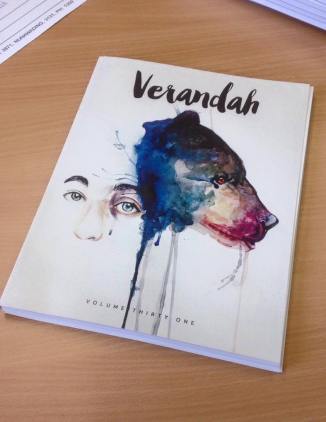
‘Being a literary major, I’ve always been told to think outside the words on the page in front of me; to see their effect, to see their purpose, and to understand their importance.
I’ve always believed that the most important thing about the words on those pages is that someone found value in them, enough to share them with the world.’
A few months ago, I started a blog where I would begin my editing career. These were the first words that I published, and little did I know how much more meaning would be assigned to them when I’d begin to read through the hundreds of submissions that we received this year for Verandah journal. It was tough, and it was long, but we narrowed them down to a wonderful bunch of writers with hilarious, morbid and frightening stories to tell. This past Sunday, we launched them for the world to see.
With a crowd of around forty people, The Owl and Cat Theatre transformed into a literary and art festivity. We had readings from some of our wonderful contributors and our prizewinners were awarded their prizes for outstanding creativity and literary genius.
I’m so excited to be able to share this with you through Busybird, as the team here is so passionate about anthologies and the joy they bring with them. Their own [untitled] was launched the week previously, and it was wonderful for them to have such a great turnout.
This type of publication is one that fosters and nurtures some of the greatest writers. As Blaise mentioned in her blog From Little Things … Busybird has been the launching pad for quite a few literary careers, and knowing that you were one of the people who saw a future in their writing must be an outstanding feeling. As Verandah has had around 30 authors every year for the past 31 years, it would take quite a bit of time to check how many authors have gone on to greater things, but it would be just as powerful to know that our humble and confused team of editors were able to give someone the confidence to pursue a career in writing. Aspiring writers ourselves, being able to find greatness in a piece is equally as rewarding as being able to stand in front of them and offer them a printed anthology with their name just inside the cover.
We also had the wonderful opportunity of meeting one of the first Verandah editors, who began this beautiful mess over thirty years ago for a new team to continue each year since. The world is in need of anthologies now as much as it was when Verandah was first launched into Melbourne’s literature scene.
Sure, publications like Verandah and [untitled] probably won’t attract a lot of attention and probably won’t sell out. They aren’t made to be financially viable, and we’ve donated more of our time to them than we have to sleeping, but they offer a world of possibilities to those who aren’t confident in their skills. They assure them that they have something to say, and that they’ve found a place where they can comfortably say it. I’m incredibly glad to be able to intern at a publishing house that sees the value in small publications (and one that has produced so many!).
We’ll be launching this Sunday the 11th of September down in Geelong for the first time ever. Though we’ve focused on being in Melbourne the past few decades, it’s important for us to move around to other cities and encourage submissions.
If you have a short story, some poetry or any other creative outlet that you want to share, be sure to watch out for anthologies looking for submissions; or if you want to be an editor yourself, keep a close eye on Verandah’s website in the next few weeks. We’re just about ready to choose a new band of crusading editors and designers for Verandah 32.
Lauren Magee, Editorial Intern
Unleash Your Inner Troll
September 1, 2016 Every story begins with an idea.
Usually, that’s something simple – maybe just an image that flashes through your mind.
A boy who lives in a closet under the stairs doesn’t know he’s a wizard.
Then, you might begin to explore this image. Who is this boy? Why is he under the stairs? Is he hiding? Or is this where he lives? If this is where he lives, what circumstances have put him in a closet under the stairs? How does he find out he’s a wizard? Is his magic already fully-formed? Is it something he has to learn? How does he learn his magic? How does magic function in this world? Is he the only wizard? Are there more? Is there a whole sub-community of wizards? Do the wizards have enemies?
Each question you ask develops this idea. It grows, and as it grows, it generates possibilities. These possibilities become the framework of your storyline. As that framework is constructed, you start to learn more about your characters, the world, and what’s going on.
Through this evolution, everything’s exciting. It’s like reading a good book, but being the first person to discover every single word, every single person, every single event, and you just want to share it with everybody you know.
It’s easy now to let enthusiasm carry you away. Many are carried away, until their story becomes unwieldy. Others ride the mess, with the intent of finding order later. Others are swallowed in the chaos and abandon all ambition of ever finding their way.
Whatever your course, this is where you need to force yourself to stop. A warning, also: Do not let the thought of your own brilliance blind you. You’re better if you lower your expectations, if not unleash not only the critic in yourself, but the savage critic – the troll.
Because this is where you need to test the suspension of disbelief in your story. What is suspension of disbelief? It’s where you create the internal rules that govern your world – this applies wherever your story takes place. These rules dictate how and why things work the way they do. If you don’t have rules, a reader will identify there’s no logic to your story. If you contravene these rules – and, remember, these are your own rules – then, again, a reader will identify a lack of logic in your story.
For example, if you were writing fantasy, how does the magic work? You might have a powerful wizard who uses magic to fight off a dragon in one scene, but then is helpless against a bandit in another. Why? Why can’t they use their magic, especially if it’s been established they’ve used it – and against a greater foe – already? What is the rule which dictates that? Convenience doesn’t work. In this case, the wizard might have a specific spell for dragons. Or he might have time to recite the incantations for the dragon, but be ambushed by the bandit (and thus not have time to prepare). Now we have rules that make sense of things. Readers like sense. It means the world has substance.
Everything that happens in your story has to be believable and internally consistent within the world where everything takes place. You can never have a reader thinking, Why didn’t they just do such and such? or They did this before – why don’t they just do it again?
So attack the suspension of disbelief behind your idea as you’re developing it. Implement rules – they don’t ever have to be expressed for the reader, but they can offer parameters in which you operate, and which govern the evolution of how and why things happen the way they do.
Issue Seven Launches!
August 25, 2016![[untitled]7_cover.indd](https://www.busybird.com.au/app/uploads/2016/08/untitledissueseven.jpg) It’s a story that many of our regular readers will be familiar with: way back towards the end of 2008, a group of us – four writers and one illustrator/photographer – bandied about ideas for a new anthology. Frustrated by the lack of opportunity for mainstream writing, we wanted something open to popular fiction. If you look at a lot of the existing journals, you don’t really see stories that might’ve been penned by a popular fiction author, such as Stephen King, JK Rowling, Lee Child, Matthew Reilly, Di Morrissey, and so on.
It’s a story that many of our regular readers will be familiar with: way back towards the end of 2008, a group of us – four writers and one illustrator/photographer – bandied about ideas for a new anthology. Frustrated by the lack of opportunity for mainstream writing, we wanted something open to popular fiction. If you look at a lot of the existing journals, you don’t really see stories that might’ve been penned by a popular fiction author, such as Stephen King, JK Rowling, Lee Child, Matthew Reilly, Di Morrissey, and so on.
So that was our goal. We wouldn’t exclude literary fiction, but we ultimately wanted to be open to everything as long as it was an enjoyable read – the sort of read where you wish you could sink right into the story, where you want to keep reading just a bit more, and where you feel regret and loss when you know you’re coming to the end.
The size of the book was meant to resemble the old paperbacks. Nobody else was doing that. All the anthologies were (and are) big. So we’d be novel (no pun intended) that way. As for the name? We bandied lots around, until our director of publishing, Blaise van Hecke, suggested we just call it ‘untitled’. It worked not only out of frustration of trying to find this title (I can’t convey how mindlessly long this search went on), but because it embodied that the anthology could be about anything.
The first issue launched in 2009 – a learning process for us, as we liaised with authors, edited stories, and dealt with printers and distributors and bookshops. There’s a lot of work that goes into any anthology – a lot of work. And it’s continued to be a lot of work throughout, with an issue almost every year – until this last one, which took longer.
Here’s an insight into putting together an anthology:
- Advertising for submissions. We put a submission call out through all forms of media – Writers Centres, Facebook, word of mouth, etc.
- The initial reading of stories. This is an ongoing process, too. You don’t just read twenty stories, pick ten, and away you go. Sometimes, hundreds and hundreds of stories are read. At least two editorial interns read every story. Everybody reads the longlists. An editorial intern also has to log all the stories into a database.
- Content meetings. We meet with interns and discuss stories. Interns often learn here what makes a good story from an examination of prose, a study of character, a dissemination of structure, and an exploration of causality and motivation. Often, we might come to a content meeting with twenty longlisted stories, and pick one.
- Editing. We go back and forth with the author to edit their story and get it to a place that we’re all happy with. Some stories only need an edit or two. Some go through ten or so edits. (As a note, most authors are brilliant through this process.)
- Order determination. A lot of people probably don’t realise this goes on, but we try to work out a balanced order for the stories. For example, we mightn’t want two tragic stories in a row. So it’s important to get this right.
- Layout. The anthology is laid out in InDesign.
- Cover Design. Usually, one of the stories inspires the cover.
- Proofreading and taking in corrections. This is done repeatedly so, hopefully, you don’t find any errors in the pages. (And we don’t want to know if you do!)
- Off to the printer. We wait for the final product.
- Organising the launch. This means organising the space, organising the catering, coordinating who’s going to come and read, finding somebody to launch the issue, working out the order of the launch, and the list goes on.
The launch is a culmination of all the hard work – a lot of it anonymous, much of it unpaid for interns (other than for what they learn) – and becomes a celebration of the achievement, a proclamation that we’ve succeeded.
We’re fortunate enough to have award-winning writer Laurie Steed launch issue of [untitled] on Saturday, 27th August at 3.00pm. If you’d like to join us, please drop us an email, as it helps with catering. Or you can check out our Facebook event here.
Honesty
August 18, 2016 Here’s a question: when you write, do you write freely and without inhibition?
Be honest. Your impulse might be to say you do. But think about it. Think about your writing. Think about the way characters react. Think about how scenes unfold. Are they uninhibited? Are you uninhibited in writing them?
Astonishingly, many writers aren’t.
And they aren’t for a very simple reason.
What would people think?
Admit it: that’s an alert in your head.
What would your partner, you family, your friends, the general public, etc., think about the scene you wrote where the killer garrottes his victim, bathes in the gore, and then plays a spot of mini golf with the kids? Or the scene where the sweet, modest loving couple engage in bondage behind closed doors? Or when the tough, macho husband breaks down, and cries on the floor of the kitchen? Would your partner, your family, your friends, think you a creep? Or sick? Or gushy? Better to temper it all.
No.
This isn’t about being shocking. Anybody can throw in a scene to shock, and sometimes authors do, because they feel that’ll captivate. It might, but not in the right way. Often, a reader will frown and even if they don’t recognise the scene as gratuitous, they’ll know there’s something not quite right.
Be true to what’s required in your writing. If that means you need to write an emotional scene which is going to have people thinking you’re just some big softy, write it. If you need to write a violent scene which is going to make people think you’re a sicko, write it. Whatever the scene, write it as it needs to be, devoid of boundaries, unfiltered, and free of judgement.
This applies to any form of writing. You could be a poet, you could be a novelist, you could be writing your biography.
You’ll know when you’ve hit a scene where you’re holding back. You’ll feel that tentativeness about the writing. It might even become diplomatic, couching the expression so that it won’t be confrontational, nor an indictment on you as a person. Other times, you’ll be racing through scenes and thinking you’ve nailed them, but because you’ve been doing this so long you’ve just learned to ignore your instincts. Have you been as real as possible? Have you been truthful with yourself and the narrative?
If you’re not going to be honest with your writing, be honest with yourself.
A Luxuriant Breakdown
August 11, 2016 Last week, we posted a purposely badly-written creative piece to show some of the issues we regularly encounter in editing. Let’s now break them down …
Suddenly
This has grown so overused, it’s almost become a cliché. ‘Suddenly, this happened.’ It’s such an easy – and melodramatic – way to show urgency.
Think of ways you can communicate suddenness in the writing itself. For example, instead of
- Suddenly, the door opened
try
- The door crashed open.
This is not to say you can’t ever use ‘suddenly’. Just make sure it’s required.
Just then
This is another version of ‘suddenly’. A lot of the time, you’ll find you can just cut it out entirely. Using the (first) example from ‘Luxuriance’:
- Just then, the phone rang.
This could just read:
- The phone rang.
Again, if you need something to happen ‘just then’, think about how you can express that through the writing itself.
However
‘However’ has become a cheat, a way to transition from one subject to another without any real logical evolution.
- Today, I am writing a blog. However, the sky is blue.
There’s no logical evolution there, but it sounds like a feasible transition due to the use of ‘however’. Think about how you’re getting from Point A to Point B. There should be a causality in how that happens.
Clichés
Clichés simply have no meaning any more. If somebody tells you their ‘blood ran cold’, beyond your basic understanding that it’s meant to communicate terror, what does it mean? Think of relatable ways to say things.
Favourite words
We all have our favourite words and phrases. In this piece, it was ‘ominously’. Try to identify your own. Sometimes, a fresh set of eyes (e.g. a workshopping group, an editor) can help you find yours. Once you know of their existence, you’ll find yourself mindful of using them.
Attributors
Keep it simple. You don’t really need to venture too far away from ‘said’ and ‘asked’. If you do, don’t get too fancy – you never want to use an attributor which is going to make the reader stop and wonder why that word is there.
Useless Modifiers
‘It’s quite hot.’ What does that mean? How much is ‘quite’? Stay away from weak modifiers (e.g. quite, somewhat, practically, basically, virtually).
Foreshadowing
Make sure your narrative sets up what’s going to follow. Don’t throw in details later just because you’ve forgotten something should’ve been introduced earlier.
One of the best examples of foreshadowing is the movie The Sixth Sense. When the twist comes, we understand everything that we’ve been seeing in a new context. At no point do we feel either cheated or confused.
Exposition
We need to introduce backstory to drive our narrative. Just be mindful of how far it goes. A good way of identifying exposition is how grounded is it in the current setting? Or do we digress into a shapeless overview of the past? Exposition, at times, is necessary and unavoidable. Just make sure it doesn’t take over.
Tenses
What tense are you writing in? Stylistically, you might fluctuate from one tense to the other, e.g. you might be writing in past tense, but when something shocking happens, you bring the story into the present tense. There’s a justification in a shift here. But, often, authors flip around unknowingly. Be conscious of the tense you’re in.
Obviously, there’s plenty of other issues to look for in writing, but these are amongst the most popular.
What you’ll find as you grow aware of these issues is you’ll be challenged to find new and innovative waves of expression that avoid all the problems that can make writing so pedestrian.