


Busybird
Welcome to the Busybird blog, where you can find helpful articles, updates, industry news and more. Make sure you stay up to date by signing up to our newsletter below.
The Fetishisation of the Printed Form
November 17, 2016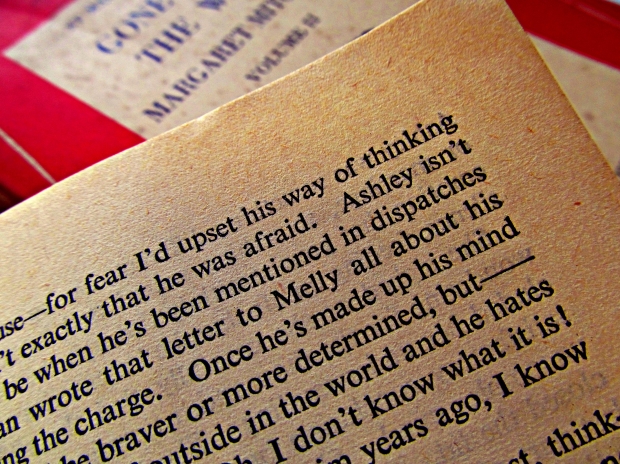 I watched a discussion at the Independent Publishing Conference where a panellist said he didn’t believe in the ‘fetishisation’ of the print book as a reason readers preferred it over the ebook. This means he didn’t believe people enjoyed the print book for things like its texture, the smell of its pages, the shape of the words, etc.
Yet most readers maintain their allegiance to the print book. That’s worth thinking about given it wasn’t too long ago many thought the emergence of the ebook would eliminate the need for the print book. That hasn’t happened. Ebooks spiked early with their sales, then hit a plateau. The print book remains as strong as ever.
Why?
The ebook is a form of convenience. From a practical standpoint, we’re don’t need to cut down trees to print ebooks. They’re cheaper and you can carry numerous books on your reader, rather than have to lug around enough books to give you a hernia. You can order any books – even ones that would be difficult (if not impossible) to obtain in print – and have them delivered to your reader instantly. If you have readers across multiple platforms (e.g. on your tablet, on your phone) they’ll automatically synchronise where you’re up to, so you’ll never lose your page regardless of where you’re reading. These are all undeniable advantages.
But readers are still faithful to the vehicle – in this case, the printed form.
And, of course, a fetishisation exists, because fetishisation exists in everyday society. Where would you enjoy a movie most – in Gold Class, IMAX, a normal cinema, watching a BluRay, a DVD, on your tablet, or on your phone? If fetishisation didn’t exist, it wouldn’t matter where you watched it, because you’d only be concerned about the content. What would you rather drive – a Ferrari, a Ford, or a KIA? If you were going out to a wedding, do you dress in your finest, in everyday casual-wear, in a tracksuit, or in your pyjamas? If you wanted to enjoy an art exhibition, would you go see Rembrandt or Joe Blow?
These examples can go on. They exist in every level of life – material, cultural, and functional. It matters to us how things look. If it didn’t, we’d dress the same, look the same, and have the same tastes. We wouldn’t lament cloudy days and revel in sunny days. Art (in any form) wouldn’t exist because we couldn’t possibly have an appreciation for it. There would be nothing but pragmatism. Everything else would only exist as a means to an end.
But appearance – and particularly beauty – appeal to us.
Why should books be any different? This is why people will collect different editions with new covers, new sizes, new looks – that fetishisation of the form matters. It gives us a tactile connection to the physical form, just as we can have tactile connections to locations, to sounds (like songs), to smells, etc. It’s about how the world resonates with us, how we interpret it, and what that interpretation means to us.
Surely, this is something the manufacturers of ebook readers recognise, given they continually strive to make ebooks look more like printed books. They try to duplicate paper colouring, the resolution of fonts, and the cosmetics behind the layout. They’ve even gone as far now to create the illusion of a page being turned. If the fetishisation of the printed form didn’t matter, why would the manufacturers bother? Why wouldn’t it just come down to electronic text on an electronic page? The answer is obviously it does matter and manufacturers are trying to duplicate that very real connection readers develop – and nurture – with the printed form.
Justifying Structure
November 10, 2016 How are you going to tell your story?
Most authors won’t even think about it. They’ll just sit down and write, and let their story take its own form. It doesn’t have to be any more complicated than that. And, lots of times, it feels the natural way to do it, so why overthink it? If it’s natural, it must be right.
Right?
No.
An inexperienced author might use reams of exposition whenever they introduce a new character. This may be natural to them. Does that make it right? To them, maybe, because this is as much as they know. But, in all likelihood, the overblown exposition will disengage most readers for whatever reason – because it bores them, because it shatters their suspension of disbelief, because it’s superfluous, and on this list goes.
Whilst the initial choice behind the structure of your story might be instinctive, it’s worth examining whether that choice (or those choices) have merit and will help or hinder your story being the best possible story it can be.
Is your story going to be first person, second person, third person, or third person omniscient? Why are you using that POV? Think about it. Think about the benefits it gives you and how it serves the story. Does the POV shift? If so, why? A story might transfer from third person (symbolising the protagonist’s disconnect from the world around them) to first person (because now the protagonist has gained a self-awareness). Does it shift from past tense to present tense to show the protagonist becomes hyper-aware of the world around them as it’s unfolding?
It’s great to feel as if your natural choices, as if your instinctive choices, will guide you to produce the best narrative possible, but those instincts are usually informed by knowledge and experience, just the way a top doctor might be able to look at a patient and – despite limited symptoms exhibited – diagnose them intuitively. The doctor isn’t prescient. They might have a lifetime of experience and education funnelling into their interpretation of what’s happening to produce – or, at the very least, complement – that single moment of intuition which produces that diagnosis.
Too many authors want to be innovative or complicated unjustifiably. They employ POV shifts, tense shifts, structural shifts (e.g. flashbacks), etc. The question always is the same: Why? It’s fine to experiment. Experimenting helps us learn by doing. But usually, the best course is the simplest. If you plan to deviate, then bring it back to that question: Why? Examine it. See if it works for you and, if it does, work out why it works for you. If it doesn’t, find out why it doesn’t.
Everything should have a reason for why it’s done outside of it simply being a natural choice. A reader will appreciate these decisions if there’s a justification and purpose behind them, even if the reader doesn’t understand that from a technical standpoint. It’ll engage and stimulate them and their interpretation of your writing. But when these changes exist arbitrarily, with no real grounding or motivation behind them, all that’s likely to happen is you’ll have your reader saying, Huh?
Inside Karma
November 3, 2016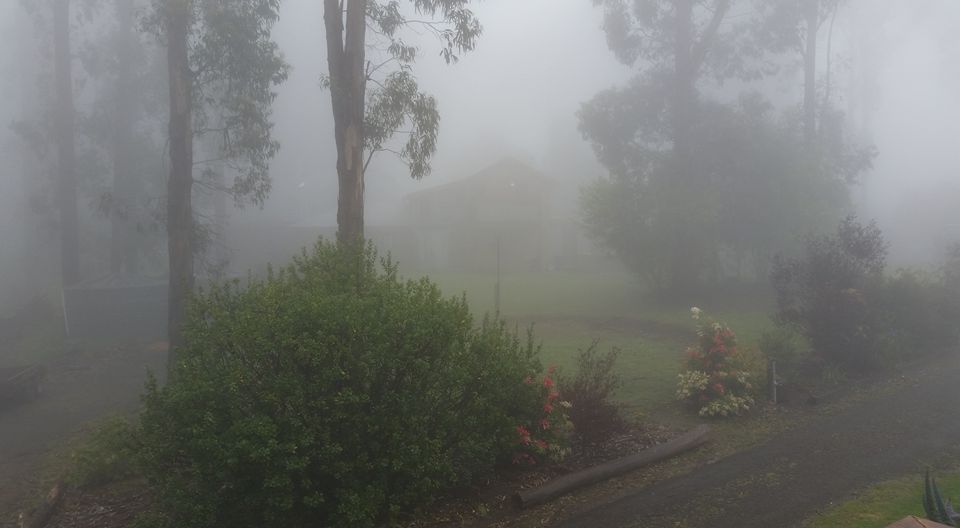 Arriving Early
Except for a gang of cockatoos screeching and catcalling from the treetops, I was alone. A mist had begun to settle, blurring the contours of the new growth eucalypts and the blackened trunks, enclosing me in a thick, white cloud. Dotted among the man ferns and lilly pilly borders, a cluster of corrugated huts sat dark and empty.
It wasn’t quite wilderness but there was something otherworldly, dreamy and a little bit fairy tale about the atmosphere, as I lingered in the car park trying to work out where on earth reception was (I was probably standing right under a sign with big red arrows).
That was our first ten minute writing exercise. I was sitting at a ‘U’ shaped table among a small group of writers, wood fire blazing, rain battering the windows, a mound of chocolates and mints and a brown paper gift bag in front of each of us. Such a nice way to start writing. The scary part wouldn’t happen until later.
Blaise and Les have run several retreats now and the program is well designed. While the retreat focuses on memoir, the workshops are equally applicable to fiction and most other types of creative nonfiction. Nonetheless, I couldn’t help but feel apprehensive when I saw the theme for this retreat spelled out in big black letters: No More Excuses.
Writer’s Block
To kick things off Blaise asked us to make a note of our roadblocks, those issues we have when we sit down to write that suddenly make scrubbing the floor by hand and cleaning grout seem so appealing. Naturally I was convinced that my roadblock was the worst, and I was sure it was incurable. Even though writer’s block is a common complaint, there is no such beast according to Les and Blaise. By lunchtime Saturday I had acquired a whole new insight into the bane of my writing life. The thing I had been bemoaning for all those years was actually a structural problem, and there absolutely is a cure.
My worst writing issue addressed on the first morning. Best workshop ever!
Dinner Time
Despite all the naughty treats, mealtimes were a delight. As a vegetarian, I was expecting dishes where I could pick out the meat, but my meals were gourmet creations: spicy pumpkin and pistachios, stuffed zucchinis and salads flavoured with red currants, toasted almonds and pomegranates. My dishes gave several of my fellow carnivores a few green-eyed moments. Lucky for me, Karen, the proprietor and chef, likes to make all her guests feel special, even the difficult ones, and lucky for the carnivores there was plenty to share around (I was quite prepared to fight for my food, and it looked as if some of the others would too).
The Scary Part
Saturday afternoon: back in the barn, a second-storey room with floor-to-ceiling windows and a hardworking wood heater, Les was handing around the five hundred word memoirs we had all had sent Blaise the previous week. What had I done? I’d emailed ‘The Lost Little Cowgirl’, a piece beset with all the problems that typically weigh down my creative efforts. It was another story-without-an-arc. Just an experiment. What was I thinking?
Every person in the room had an important and fascinating story to tell: from a young mother fleeing the Black Saturday bushfires to a deliciously creepy tale about an anaesthetist tempted to go rogue. Feeling like I didn’t belong, I hunkered down in my seat and tried to hide my nerves. Colleen was the first to comment: ‘It works once you know it’s a story within a story.’ I was touched. The whole group engaged with my strange little piece with curiosity, insight and a sense of humour. Even the scary bits turned out to be fun.
After each critique, Les returned our writing with a professional edit attached. And there, among the suggestions, four comments down, was the nugget I had been searching for. Maybe it would not make a full arc, but it would definitely raise its belly off the ground.
Afterwards
I had wondered what it would be like to spend a whole weekend immersed in my writing and I conjured many scenarios in the weeks before the retreat. What I didn’t expect was to feel so snug as rain and mist sealed off Karma. It was like an island somewhere slightly to the north of reality. And now, as I take my mind back, I have been surprised to find that there are actual, concrete solutions to the slippery swag of issues I lugged up the mountain.
Workshops and retreats are one of the best ways I know to build motivation and momentum and, little by little, I can feel myself edging closer to that place where there will be, No More Excuses.
P.S. A big thank you to everybody for making the weekend so special and an extra thank you to my two lovely nest mates, Liz and Colleen.
– Lisa Roberts
An Exploration of Karma
October 27, 2016 We’re back from Karma!
And, as you might expect, this is when we give you the sell about what a great weekend it was.
Well, you know what?
It was!
This was our third Karma Writing Retreat, and before each of them there’s been the tiniest trepidation about how groups will gel. You just never know when strangers are relocating to live and interact with one another over the course of a weekend. But every time, the retreat has been a joy.
And here’s a breakdown as to why that happens.
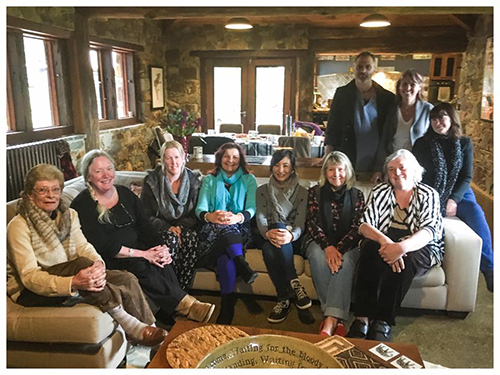
The Karma October 2016 group.
Writers
Arguably, the most difficult thing about being a writer is, well, being a writer. Most people think that all it takes to write a story or a poem or a work of nonfiction is to just sit down and spill the words onto the page. They don’t understand how difficult it is reaching into oneself to find something of value, and to then articulate that in a way that’s going to be structured, cohesive, and engaging. But writers understand. And they understand the issues that pop up – the difficulty in getting their words right, the nagging self-doubt, the intimidation of writer’s block … and this list goes on. It gives writers a frame of reference for discussion even before they’ve met. It gives them empathy with one another.
We had eight participants (and, for one, it was her second successive Karma retreat) this week, a full house for us – the Retreat can fit more, but we think eight is a good number for workshops. Ten people (eight participants, two facilitators) in a room is a conversation; any more, and it becomes a din.
None of the participants knew one another prior to the weekend. But they – along with us, as the facilitators – immediately engaged (and now the participants are going to stay in touch and form their own writing group).
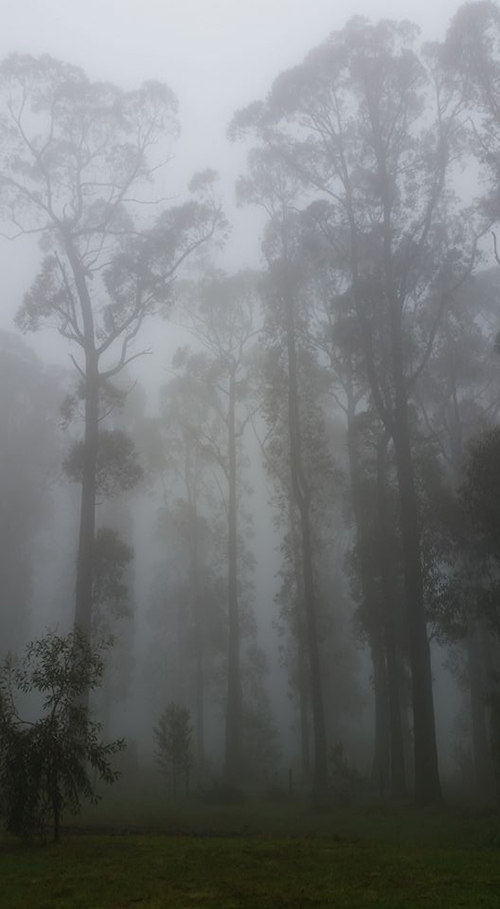
A misty Kinglake morning.
Karma
When Blaise first came up with the idea for a retreat, she scoured possible locations, many of them coastal, but didn’t feel any fit. Karma was a revelation, and also fit Blaise’s own emotional connection to the bush, given she’d grown up on a commune.
Hearing ‘Kinglake’, people might automatically think the retreat is rustic, some backwater with outdoor toilets, cold-water plumbing, and meals cooked over a fire. Karma comprises a main house (with kitchen, lounge by the fireplace, a couple of bedrooms), and ‘nests’, the equivalent of bungalows that spider-web out from the main house. The nests have their own kitchenettes, bathrooms, and heating (fires, and split heating systems; the rooms have bathrooms and split heating systems). It’s luxury nestled in the bush.
Karen
Karen, Karma’s host, deserves to be singled out. Charming and funny, she’s led an amazingly storied life, and painstakingly attends to every need – it’s assuring when you have dietary issues to know that they’re taken care of. Every meal she prepares is a feast (often, the feedback we get raves about the meals), and also comes with desert. You can consider yourself spoiled.
It actually gets to the point that she anticipates your needs before you ever need to articulate them.
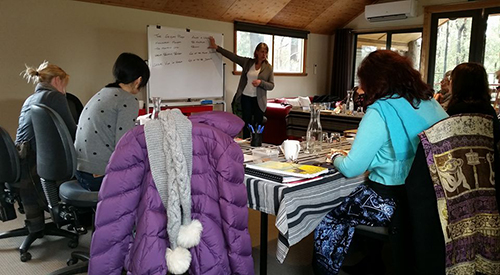
Blaise talks about publishing options.
The Workshops
The workshop lessons and exercises are pre-planned, but the regimen remains fluid to accommodate any specific interests the participants have – on this occasion, many of them had an interest in structure. Also, throughout each workshop, particular interests (or needs) might pop up that we then follow and explore.
The workshops provide lots of stimulating discussion, introduce writers to lots of dos and don’ts, and help them understand how they’re going to tackle whatever it is they want to write, and the publishing options that they can pursue. There’s also an actual workshop of each participant’s writing, which gives them a good idea what to look for in the rest of their work.
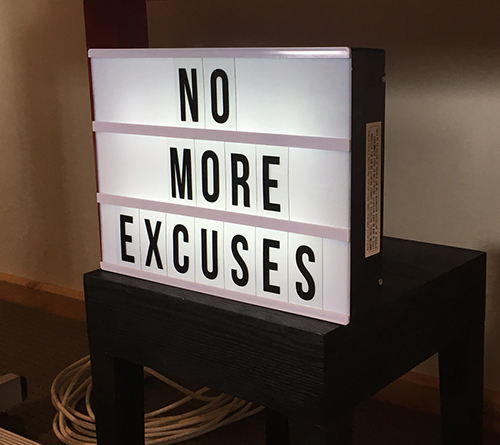
What are you waiting for?
Transformation
Every participant who’s come to Karma has come nurturing a single question related to their writing, or to their journey as a writer. Examples of these questions are:
- I’ve written in another field; are those skills translatable to what I want to do now?
- What’s the story I want to share?
- How do I get started?
- Can I really write?
- What are the tools I need?
Etc.
And then they’ve come away from the retreat confident and enthused about where to go next.
That transformation is at the heart of what Karma’s about – finding a way to unravel the doubt and to proceed with whatever your undertaking might be. Blaise’s motif for the weekend was ‘No more excuses’, and it’s ultimately about realising – about learning – that’s a truth you have to live by if you want to write.
There are no excuses.
Just write.
And, finally, some praise …
Here’s what this weekend’s participants had to say …
- ‘Just a huge THANK YOU. I LOVED it.’
– Liz
‘Great for novices through to experienced writers. Highly recommended.’
– Jo
‘I learned a lot about writing and publishing.’
– Maryanne
‘If you want to be a writer, do this course!!’
– Linda
‘It’s valuable in terms of people in need.’
– Jude
‘I find workshops help me develop and maintain momentum, and this one was outstanding.
– Lisa
‘I found it extremely informative/useful.’
– Christina
‘Great writing program. Very supportive. It was fantastic!’
– Colleen
Look for our next Karma Retreat in about May of 2017!
Postscript: Want to read the experiences of one of the participants? Check out Christina’s blog here: The art and soul of writing.
Pop Your Bubble!
October 20, 2016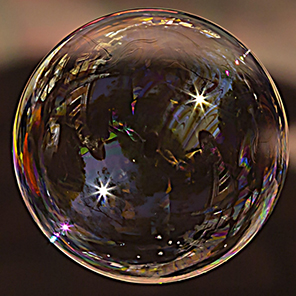 The best way you can learn to write is by writing.
It doesn’t matter how much theory you gorge on, until you execute, until you learn how to articulate your imagination, structure your story, and develop your writing processes, you will never learn to write. It’s in the writing that you work out how you do things, find your voice, and grow as a writer.
But there is a danger in existing and trying to evolve singularly in a bubble. You could write book after book after book. But how will you know what you’re doing well and what you’re not doing well? You could be writing reams of exposition. How’re you going to know? You might think it’s working for you, and just continue to do it, not realising what you’re doing is to your detriment.
This is where it’s important that you do get challenged.
It might just come in submitting. Lots of places use form rejections – usually, they do so not because they want to be cold and impersonal, but because it’s just too time-prohibitive to write a personal response to everybody submitting. However, some journals still offer feedback, as do competitions. Look for those who do (especially if you’re paying money to enter a competition).
Workshops are another great place to be challenged. Here, you can learn about components of writing that you can take away and apply to your own work. You might learn about active versus passive sentences, go away, and in reviewing your own work, find that you write too passively. This is something you might never have encountered if you stayed inside your bubble.
Along the route of workshops, courses are another avenue you might take. Some might not want to commit to some long period of schooling, but there’s always short courses. Find something that appeals to you either personally, or to what you’re writing. There’s lots of great stuff out there.
Find people you trust to share your writing with, people who are going to give you constructive criticism (which usually rules out family). You could join or start a workshopping group, or just find specific people you trust. With the advent of email and the assistance of Track Changes, it’s so easy to do things electronically nowadays.
Pop your bubble!
You need to write. You need to have something down on the page to work with so you can find what your strengths and weaknesses are – where you’re doing okay, and where you can improve. You’ll never know any of this until you do write, because your writing is going to behave as your frame of reference. Writing is always the key. But, at some point, you will need some sort of exposure to learn new things you can apply, or to examine where you need to improve. Just remember something paramount as far as the latter goes: be open.
Don’t ever think that your writing is infallible. Don’t ever believe that you’ve always got it right, and everybody else has got it wrong. One common denominator amongst the better writers is that they’re all open to being challenged, because they recognise that’s how they’re going to get better, and that’s how they’re going to improve whatever they’re working on.
The moment you close yourself off, you’ll stay where you’ve always been.
In a bubble.