Busybird
Welcome to the Busybird blog, where you can find helpful articles, updates, industry news and more. Make sure you stay up to date by signing up to our newsletter below.
Finding My Way
June 23, 2022I have never been so naïve to believe that I can do anything that I want.
In fact, I have never even believed that I can do anything that I set my mind to.
Were either of these things true, I wouldn’t be half as stressed by schoolwork, wouldn’t cripplingly suffer from impostor’s syndrome any time I attempt to complete said work, wouldn’t scrap the work within two minutes because it isn’t flawless on the first attempt, and I wouldn’t be unsuccessful in any of my endeavours rather than just a few of them.
Hence, when I am told to write about what I want to do in ‘the future’, I am impossibly lost. Frankly, I have forever believed that such a concept as ‘the future’ is too distant and too obscure to be important to the present.
What I was naïve to believe is that the future stays distant; it does not. Let’s just say, that awakening was rude.
From an early age I have been in touch with creativity: reading, drawing, writing, imagining. I once utilised them as an escape.
As I aged, however, I subconsciously recalibrated those loves to recognise the beauty of the ‘How’.
How is that book so emotionally impactful?
How is that artwork created to convey tone and message?
How is this prose connoting broader messages?
How does art, in any form, inevitably reflect concepts of the world around us?
I like that I ask questions. It makes me an analytical person and somebody who likes to investigate with a fine-tooth comb, whether it be art or media or ideas or people or societies.
But upon realising that my ‘future’ is rapidly approaching, I am facing it in search for how my analysis will help me. Or, more appropriately, how it can help me.
When I began to ask ‘how’, I said that I wanted to work within ‘Art’. There was a period when I wanted to draw, there was a period when I wanted to graphic designer. But I reminded myself that I cannot do everything.
Some things are for specific people; I could call myself an artist all I wanted and I could watch as many YouTube tutorials as I possibly could, but never could I ever learn how to draw hands. I realised that within the visual art spectrum, I neither had the spark nor the skill to get it perfectly accurate or perfectly inaccurate. My pieces always looked like an attempt at one or the other.
So I turned to my other crutches – reading and writing – and it is there, in that corner of ‘Art’, that I began to think I could find myself. I can see myself in this elusive world known as ‘The Publishing Industry’ not only because I can see the possibilities of my analysis, but because I can see the possibilities of my contribution to art that begs to be analysed, investigated and appreciated for its facets.
Ultimately, I don’t know where I want to end up within such a gargantuan industry – writer or editor or designer (probably not that one) or agent or marketer or something in between at a publishing house or magazine company or news corporation – but I know that I want to be able to implement nuance in our written language, which ever so needs it.
Harrison Abbott
Busybird Work Experience Student
Savage Ironies
June 14, 2022Blaise was a big believer in book launches. She saw them as a celebration of all the hard work an author’s put into their book.
At Blaise’s funeral, her mother, acclaimed author and artist Lin Van Hek, spoke about how she and Blaise had picked something out for Blaise to read at Lin’s funeral, assuming the natural order that a parent would precede their child in passing. Lin spoke about how it was a ‘savage irony’ that she was now reading that piece for Blaise’s funeral.
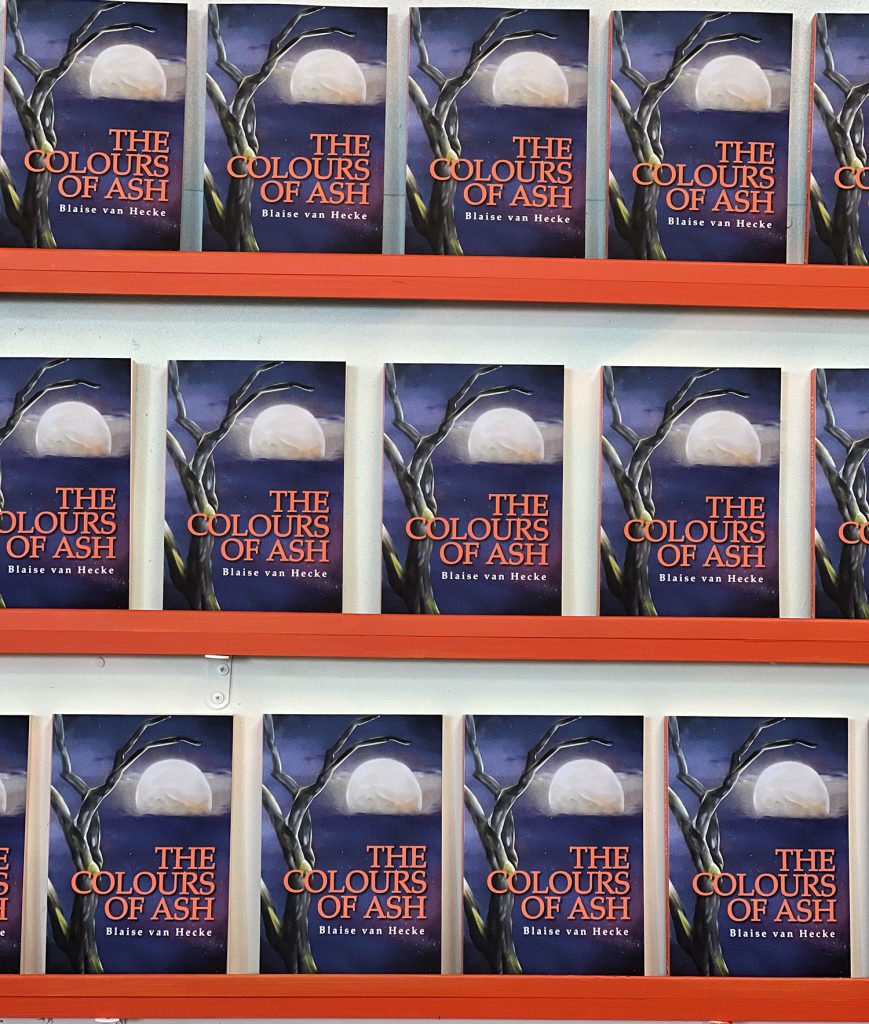
One of Blaise’s literary cornerstones was her novel, The Colours of Ash. She had been working on it for about twenty years, juggling it and the other responsibilities in her life.
In the last ten years, she also wrote and published three other books: the publishing guide, The Book Book: 12 Steps to Successful Publishing, and the two memoirs, The Road to Tralfamadore is Bathed in River Water (about her early life, growing up on a hippy commune in the 1970s), and 50 Days for Fifty Years (about walking the Camino de Santiago as a bucket-list item).
But I’d like to believe that her novel (and fiction) was her great love. She was a voracious reader – she’d read anything, but predominantly fiction. And the book was the literary love that she kept returning to, kept working on to get right.
She messaged me early in January to tell me she was planning to finally publish The Colours of Ash.
After she passed, her husband Kev, his friend/bookkeeper Kate, and I were going through Blaise’s work diary trying to get a sense of what else she’d planned for Busybird this year and found she’d tentatively pencilled in 15th May as a possible launch.
It’s another savage irony that she’d worked so long on this novel (over one/third of her life) and that she encouraged authors to throw book launches, to celebrate their book’s arrival into the world, and now we’ll have to launch her book without her.
But she’d finished with the actual manuscript, and was preparing to go to layout – that’s when the text is dumped into design software and formatted for printing. She’d also asked her son, talented artist Jack Howlett, to paint an image for the cover. It’s an image, I understand, she loved, as it perfectly represented what she had in her head.
She gave her husband, Kev, and myself just enough information that in the wake of her death, we were able to piece together what we needed to do finish The Colours of Ash.
That’s what we’ve done in the last couple of months. We hope we realised Blaise’s own vision as closely as possible to what she would’ve wanted.
The Colours of Ash will be launched tomorrow.
Here are the details:
When
7.00pm
Wednesday
15th June
Where
Busybird Publishing
2/118 Para Road
Montmorency 3094
We hope to see you all there.
Les Zigomanis.
Notes from an Intern
February 4, 2022
Before starting at Busybird I had a rather small view of the publishing world and what work really went into creating the amazing books that line my shelves. I thought all the hard work for books came from authors who had to write and create the novel, drawing readers in and building a story from their own imaginations. Whereas publishers basically printed books; job done, book sold. How wrong I was.
Reading through the list of intern tasks, I was shocked to see how much was required to get a book into the world, and how much I’d have to learn. All these small things that are easily overlooked; things like registering an ISBN, inputting information for printing, choosing the paper a book is printed on, deciding on the right font (so many choices), and the constant adjusting of covers to make them perfect. But throughout this internship I have been able to experience all these small things that complete a published book. I have also learnt some things I never even knew had to go into publishing, like registering books with the National Library.
Coming into the internship, I was looking forward to editing people’s work, since that has always been a dream of mine, getting paid to read books. And I was not disappointed. I have been able to read some amazing stories from local authors, and, hopefully, I have been able to help make them the best they can be.
However, it hasn’t always run so smoothly. With COVID lockdowns preventing us from coming into the studio, interning from home was a must. While this meant being able to get a lot of editing and reading experience, which I loved, it wasn’t the same as being in the studio learning things properly and having Oscar sit at my feet or bring me a stick from his walks. Thankfully, Zoom was around so we could still learn things, although nothing is ever the same online.
Hearing that I could come in after lockdown was amazing, having only been in for a couple of days before having to work from home, but it was also a bit of an information overload. All these things that I had only seen Blaise do on her computer over Zoom were suddenly real and I was doing them, ahh! But playing around with them a couple of times, especially playing around with layout on InDesign, gave me some more confidence and continued to make me realise how much work publishing is, not just printing books at all.
Overall, interning with Busybird and learning from Blaise and Kev has been an eye-opening experience and one that has cemented my love for editing and grown my appreciation for all books. It has been an amazing experience to be a part of the process in creating the objects that have filled my bookshelves, imagination, and spare time my entire life.
Claire Hone
Outgoing Publishing Intern
Publishing Internships
January 28, 2022
As an avid reader and writer, a career involving the magic of words appealed to me from a very young age. I was constantly in awe of the worlds and voices that could be created with some paper and ink, and I wanted to be involved in that. However, the years rolled by, and the looming decision of my adult career grew larger and more urgent. People gave their opinions whether I asked them or not.
‘There’s no money in book publishing.’
‘Shouldn’t you consider something more stable, more certain?’
No matter how they phrased it, I could always read the underlying message: You can’t do it. To be fair, maybe I was layering on my own self-doubt to perfectly reasonable statements, but in the end, I listened to what they were suggesting. Rather than follow the path I’d been on since a child, I took a detour and enrolled in Veterinary Biosciences at university.
One semester. That’s how long I lasted.
As students, we were asked to volunteer with a veterinary clinic during our mid-year break. I volunteered for six weeks at my local vet clinic, caring for the animals, observing surgeries, and assisting the clinic staff to the best that a first-year student could (or was allowed to). I learned a lot about myself at that vet clinic, and I gained an immense amount of respect for the people who work there, in any capacity. After the six weeks, I deferred from my course and asked my retail manager to extend my hours.
A year and a half later I enrolled in a Bachelor of Arts, chose my majors, and began my search for editing internships. Now, a recent graduate, I’ve completed two internships and have toed the line of a career in publishing. To me, the failed internship – if you can even call it that – has been just as valuable as the two internships that I completed and loved.
Working at Busybird Publishing has affirmed everything I knew about myself and given me the skills to take that first anxious step into meaningful employment. The skills are, of course, the technical and professional credentials that will help with my employability. But more so, I feel secure in my own power to decide my future.
Whether you’re a student, a recent graduate, or looking to change careers, internships provide you with a trial into the job that you want. And, if you can find a mentor that will help you along the way, you’ll have built connections and real, relevant experience that is invaluable.
Brooklyn O’Connell
Outgoing Publishing Intern
How lowbrow fiction is carrying us across the murky waters of this pandemic
December 3, 2021
In early 2020, Melbournians in lockdown found freedom in new hobbies: baking a fresh loaf of sourdough, learning to crochet, tie-dying jeans, or learning the latest TikTok dance. When the little bubble of our world became restricted, we found creativity in the corners of our homes.
Many people also turned to their bookshelves for comfort. Book sales soared as we realised that, for a while, our world would be restrained within the pages in our hands. And so we held on to more books, more pages. I, myself, stretched for fiction, grasping for a chance to narrow my focus to the pages of interdimensional space travel, magical realms, and shocking plot twists. When the news became too overwhelming, I would reach for a novel and there I would feel safe. In the pages.
Many of the narratives I felt drawn towards were easily found in my local bookshop, or listed on the homepage of a large bookstore website. As the level of restrictions increased, so did my google searches for ‘Best Books for Escapism’. Lowbrow fiction flooded these search results.
To understand lowbrow literature, we need to take a quick glance at its predecessor, ‘highbrow’. This term was first used in print in 1884, but wasn’t popularised until it appeared in a piece for The Sun of New York City in 1902. It was derived from the pseudoscience of phrenology—the study of skull shape as a determiner of character. Highbrows were seen as more culturally and intellectually advanced, whereas lowbrows focused more on entertainment and ‘simplicity’. And there, resting on the fence somewhere in between, like a cat surveying its surroundings, is the ‘middlebrow’. Middlebrow literature is the novels produced in mass, yet tackling the same intellectual topics as the highbrows. Unlike their older sister, ‘lowbrow’ and ‘middlebrow’ are typically used as derogatory terms.
Rooted in a system interwoven with race and class, ‘lowbrow’ literature grew in popularity in the era when mass production was taking off. As literature became more accessible for the lower classes, the upper and upper-middle classes found themselves no longer the main consumer of novels. With this, a sort of snobbery ensued, as the upper class deemed highbrow literature as ultimately superior.
Highbrow literature and non-fiction novels certainly do have their place; they are educational and can inspire critical thinking on crucial topics. Whether you’re reading a feminist manifesto, an anthology of short stories about race, a non-fic about the effects of climate change, or even sifting through your local newspaper, there is a time for writing that provides the reader with facts and complex theories.
However, one of the lowbrow genres greatest superpowers is that it is a great source of entertainment. The lowbrow reaches diverse groups of readers, and is usually easy to devour. It is also highly accessible, being produced and distributed in great quantities. Genre, escapist, or lowbrow fiction—whatever you want to call it—permits the reader to indulge in an alternate reality. A reality separate and far away from the reality of a pandemic. It is a type of writing that allows the reader to briefly live within a world borne by an author; a world where the reader is liberated from daily responsibilities.
In fact, by absorbing its reader into the world of fictional characters so effortlessly, lowbrow novels do something which ‘higher’ literature cannot; it encourages all those beautiful qualities that are so important for coping in a pandemic—compassion, empathy, and an understanding of self. Norwegian psychologist Frode Stenseng explored this theory, and divides escapism into two categories: self-suppression and self-expansion. He acknowledges that a desire to seek escape is indeed healthy, and leads to a more informed understanding of self.
In a 2013 interview with The Guardian, bestselling fantasy author, Neil Gaiman explained it this way:
“If you were trapped in an impossible situation, in an unpleasant place, with people who meant you ill, and someone offered you a temporary escape, why wouldn’t you take it? And escapist fiction is just that: fiction that opens a door, shows the sunlight outside, gives you a place to go where you are in control, are with people you want to be with (and books are real places, make no mistake about that); and more importantly, during your escape, books can also give you knowledge about the world and your predicament, give you weapons, give you armour: real things you can take back into your prison. Skills and knowledge and tools you can use to escape for real.”
Fiction provides us with the mental and emotional tools to get us through tough times. For some, this might be a screw driver to work away at the nuts and bolts of difficult thoughts. For others, it might be a spoon for consuming as much of the imaginary as possible. For me, fiction is a life raft.
During the past year and a half, a simple walk down the street becomes a reminder of life’s shifted reality: the masks, social distancing, the businesses that haven’t survived. I feel stuck, like I’m swimming in water that’s been polluted. It’s pulling me under. But, when I return home, I have that bookshelf waiting for me. The dust-less, patient, well-loved bookshelf. And on it are the lowbrow books that lift me from murky waters and return me to the comfort of fiction.
Brooklyn O’Connell, intern